
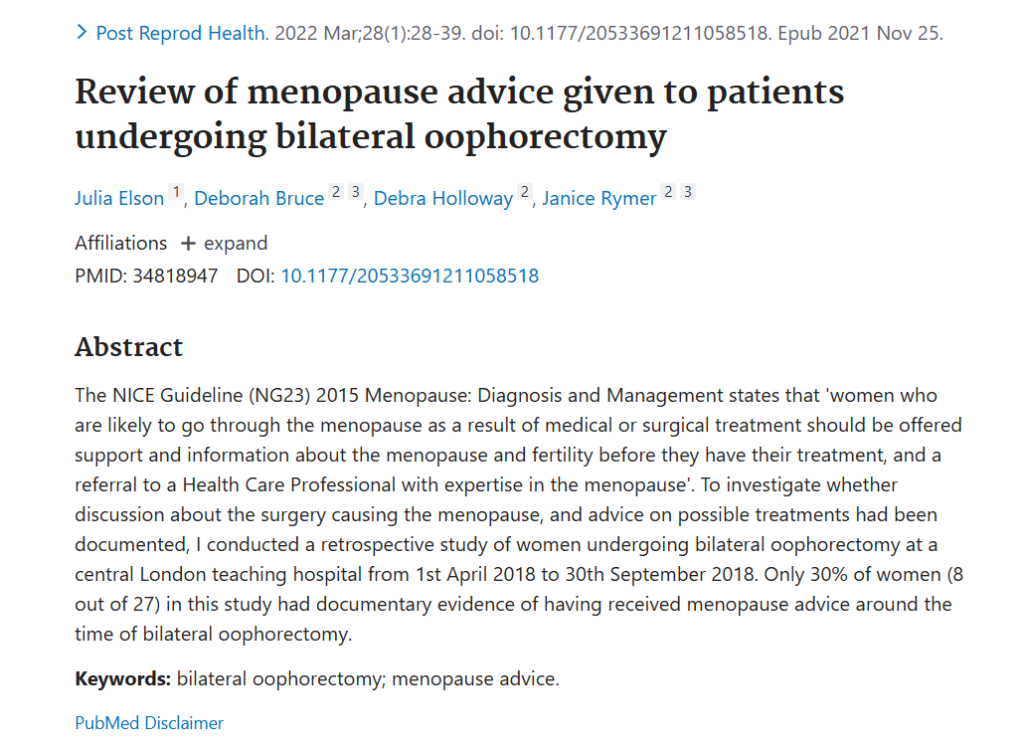
RECENT STUDY: ONLY 30% OF WOMEN RECEIVED MENOPAUSE ADVICE BEFORE THEIR SURGICALLY-INDUCED MENOPAUSE!
A study published in the Journal Post Reproductive Health (April 2022) revealed that only 8 out of 27 women from this study who had had both ovaries surgically removed, had been given menopause advice prior to their operation!
Review of menopause advice given to patients undergoing bilateral oophorectomy – PubMed
What Is Surgical Menopause?
This is the surgical removal of both ovaries which leads to an abrupt and sudden decline in female hormones which can cause more severe menopausal symptoms than a “natural menopause” which is more of a gradual process.
Why Are Ovaries Surgically Removed?
The surgical removal of both ovaries may be necessary in the context of a gynaecological cancer (e.g. ovarian cancer).
However, it can also be a choice in some instances if a woman is having a hysterectomy (the surgical removal of the womb) for non-cancerous reason (e.g. fibroids). In this context, the woman can decide whether to remove the ovaries or to leave them in situ.
Why Is It Important To Have Menopause Advice Before A Bilateral Oopherectomy?
Informed consent is important before any medical procedure which includes knowing the potential benefits, risks and complications before making a final decision about it.
It is important that it is explained to women that bilateral oophorectomy will result in a surgical menopause and that they are forewarned that they will most likely start to experience severe menopausal symptoms immediately after their operation.
Many women are sadly unprepared for the surgical menopause and do not know what is happening to their bodies when they suddenly start experiencing hot flushes, night sweats, severe anxiety, low mood, brain fog, low libido…etc
Women need to have the opportunity to discuss their menopause treatment options BEFORE their operation so that the treatment can be commenced immediately after the operation.
This is especially important in younger women who tend to suffer the most in terms of the long-term complications of oestrogen deficiency (e.g. osteoporosis, cardiovascular disease) if they do not receive the timely menopause advice and treatment.
Having menopause advice will allow women to make an informed decision about whether to conserve their ovaries (when safe to do so) or not. Ovaries should not automatically be removed with every hysterectomy procedure.
Should I Keep My Ovaries?
I would always encourage women to leave their ovaries alone whenever safe to do so because they are a very important gland similar to other glands like the thyroid.
If menopause advice is not provided by your Gynaecologist, please bring up the discussion yourself and/or contact a menopause specialist.
Menopause education is unfortunately not mandatory in many healthcare professional training including Gynaecologists so the lack of pre-operative menopause advice is not intentional however, this really needs to change!